Why Seminyak Is Not Canggu (and What It Means for Yield)
For yield stability and premium positioning, Seminyak generally outperforms Canggu. Seminyak is a mature, higher-ADR market with established affluent and long-stay demand, which tends to produce steadier occupancy. Canggu offers stronger headline growth but more volatility, driven by a younger, nomad-led crowd. Different goals favour different areas and that distinction shapes returns.
TL;DR
Seminyak and Canggu are often discussed as interchangeable, but they attract different travellers, command different rates, and carry different risk profiles. Seminyak’s maturity tends to support stable occupancy and stronger average daily rates, making it well suited to investors who prioritise yield consistency and a premium guest base. Canggu can deliver faster growth but with sharper seasonal and demand swings. The right answer depends on whether you value stability or aggressive upside.
Key Takeaways
-
Seminyak is mature; Canggu is high-growth. Maturity tends to mean steadier occupancy and pricing power; growth tends to mean opportunity paired with volatility.
-
Traveller profiles differ sharply. Seminyak draws affluent couples, families, and longer-stay guests; Canggu skews younger, nomad-driven, and price-sensitive.
-
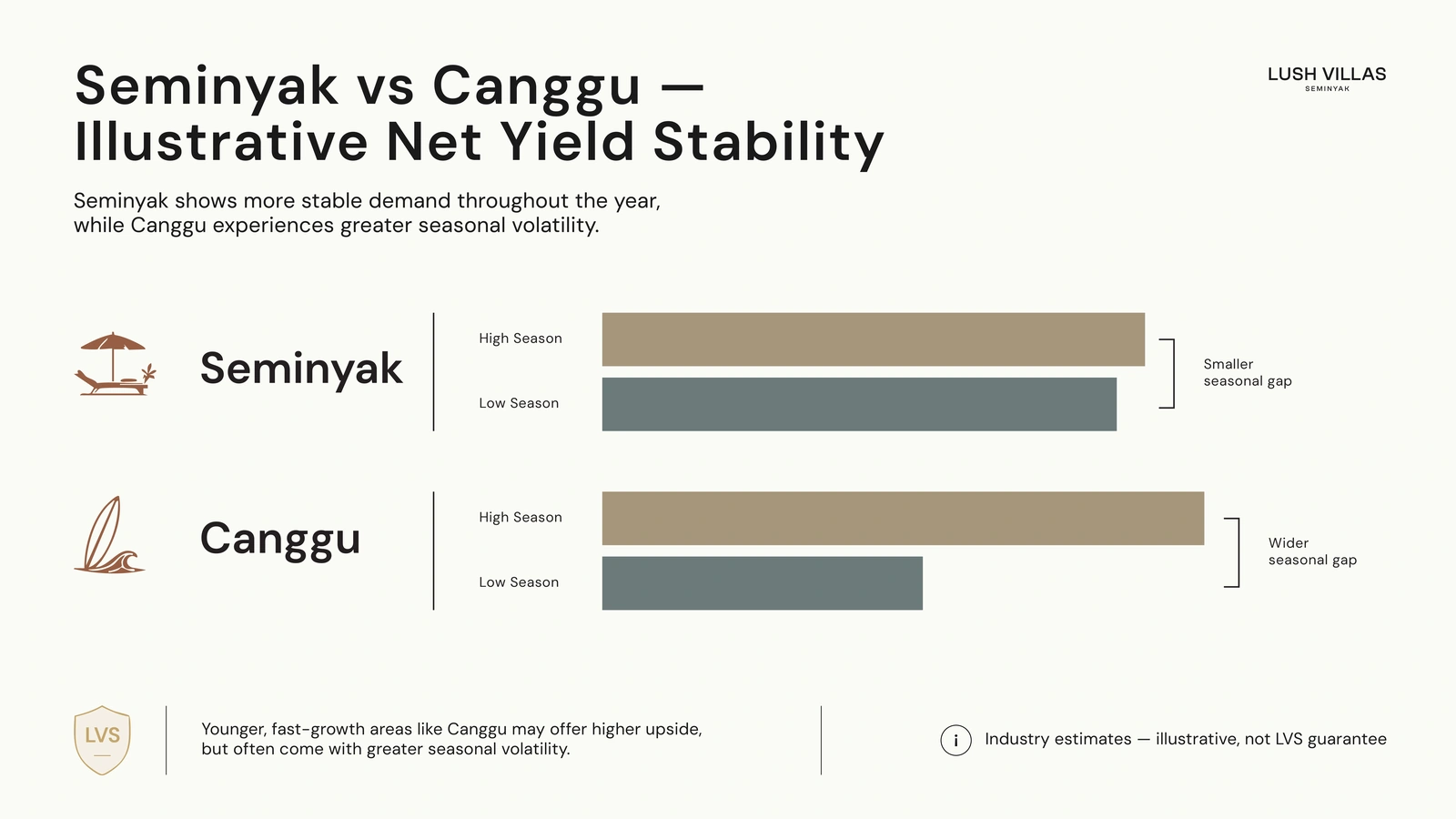
ADR and stability favour Seminyak in most industry estimates, which supports more predictable net yield.
-
Lush Villa Seminyak (LVS) projects a net yield of 8.8–13.7% (projected, not guaranteed), informed by Nova Escapes operating data across Bali and Australia.
-
There is no universally “best” area only the best fit for your risk appetite, time horizon, and lifestyle goals.
The Short Version of a Long Debate
Ask ten people where to buy a villa in Bali and you will hear two answers more than any other: Seminyak or Canggu. They sit only a short drive apart, yet they behave like different markets. Treating them as one is the most common mistake international buyers make.
This is an honest verdict from a Seminyak operator. Lush Development Group builds and operates here, and our view is shaped by real operating data through Nova Escapes, which manages 20-plus villas across Bali and Australia. That perspective comes with a bias toward what we know — so the aim here is to be fair to both areas and clear about where each one genuinely shines.
Two Markets, Two Personalities
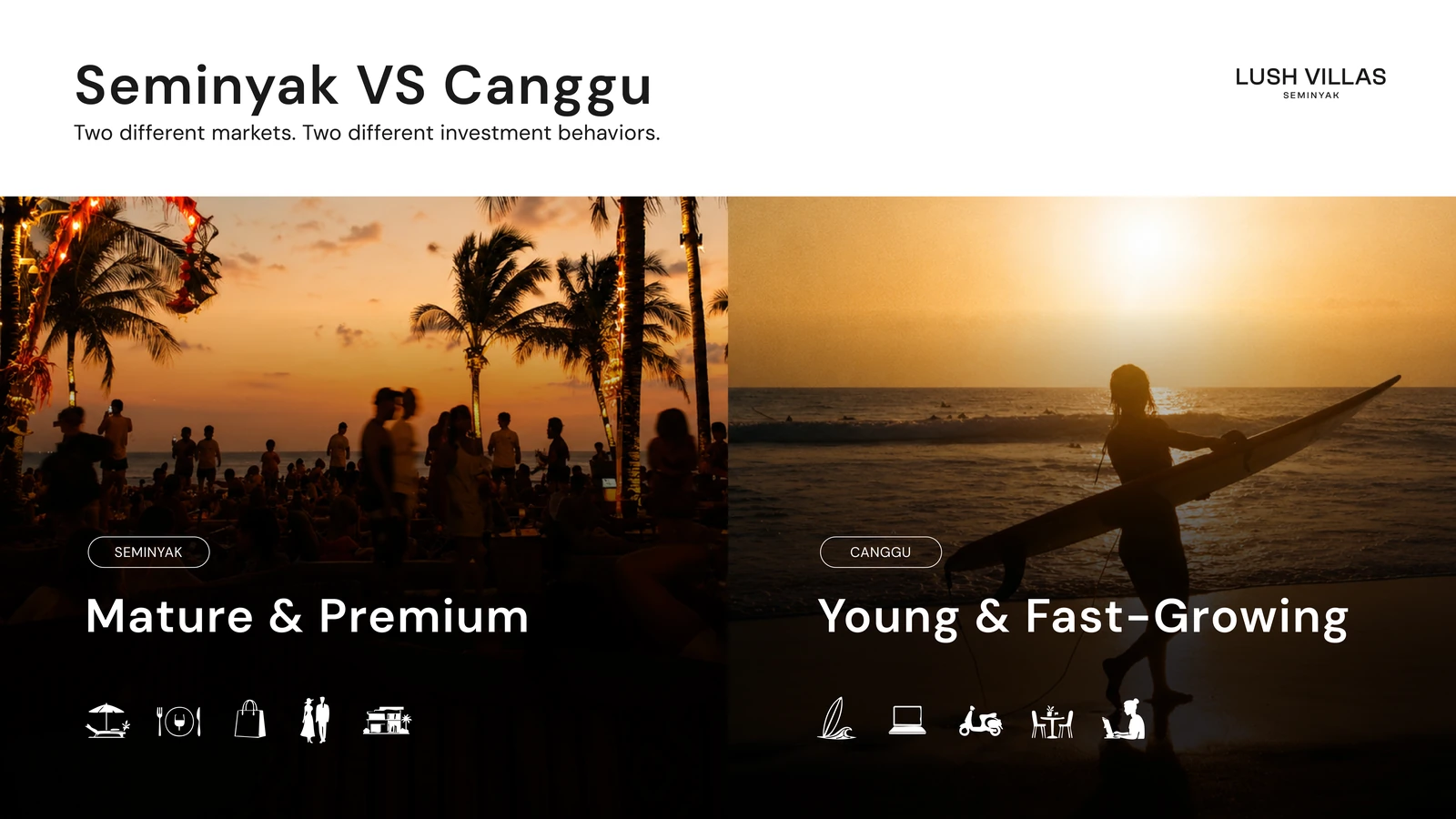
Seminyak: mature, premium, predictable
Seminyak has been Bali’s established luxury district for well over a decade. Its infrastructure, dining, beach clubs, and retail are settled rather than emerging. That maturity matters for investors because it tends to translate into reliable demand across more of the year and a guest who expects and pays for a higher standard.
The typical Seminyak traveller is an affluent couple, a family, or a longer-stay visitor who values walkability, service, and proximity to a polished beach scene. These guests book further ahead, stay longer on average, and are less likely to abandon a destination when the next trend appears. For a villa owner, that profile is the quiet engine behind occupancy stability.
For a practical view of what walkability means around this part of Seminyak, see our Seminyak 10-minute radius guide.
Canggu: younger, faster, more volatile
Canggu is the growth story. Over recent years it has become the centre of gravity for digital nomads, surfers, wellness seekers, and a younger international crowd. New cafes, co-working spaces, and developments appear constantly, and that energy has driven rapid increases in both visitor numbers and property supply.
That same dynamism cuts both ways. A nomad-driven market is more sensitive to seasonality, longer-term-rental price competition, and shifting tastes. Rapid new supply can pressure rates. The upside can be real, but it tends to arrive with wider swings — and a heavier reliance on price-sensitive, flexible travellers who can leave as quickly as they arrived.
Seminyak vs Canggu: Head-to-Head
The figures below are general market context drawn from industry estimates, not guarantees and not LVS-specific results. They are intended to illustrate the difference in profile between the two areas.
|
Factor |
Seminyak |
Canggu |
|---|---|---|
|
Typical traveller |
Affluent couples, families, longer-stay guests |
Younger travellers, digital nomads, surfers; more price-sensitive |
|
Average daily rate (ADR) |
Higher; premium positioning (industry estimates) |
Moderate to high, but with wider spread (industry estimates) |
|
Occupancy stability |
Steadier across the year; established demand |
More seasonal and volatile; trend-dependent |
|
Gross vs net yield profile |
Often slightly lower gross headline, but more stable net once costs are accounted for |
Can show attractive gross figures, but net is more variable |
|
Vibe |
Polished, established luxury; refined dining and beach clubs |
Energetic, casual, fast-evolving; cafe and surf culture |
|
Best-fit buyer |
Prioritises stability, premium guests, predictable returns |
Prioritises growth upside and accepts higher volatility |
A note worth underlining: a high gross yield can be misleading. What lands in an owner’s account is the net figure, after management, maintenance, taxes, and vacancy. A more volatile market can advertise impressive gross numbers while delivering an inconsistent net. For a fuller explanation of why this distinction decides real returns, see our piece on net versus gross yield in Bali.
What the Operating Data Suggests
Numbers in isolation can mislead, so it helps to ground them in operations. Nova Escapes manages a portfolio across Bali and Australia, and that day-to-day experience informs how Lush Development Group thinks about Seminyak demand: who books, how far ahead, how long they stay, and how rates hold through quieter months.
The pattern we see is consistent with the wider market view. Seminyak’s affluent, longer-stay guest base tends to smooth out the seasonal dips that hit more nomad-dependent areas harder. That smoothing is what supports a more predictable net result over a full year rather than a strong high season followed by a soft shoulder.
This operational view is one input behind the projected net yield range for Lush Villa Seminyak of 8.8–13.7% projected, not guaranteed. That range reflects positioning, unit type, and prevailing market conditions, all of which can change. It is an estimate informed by experience, not a promise. For broader demand context, our Bali tourism 2026 data article tracks the trends underpinning this outlook.
So, Seminyak or Canggu to Invest?
There is no single best area to buy a villa in Bali only the area that best fits your objectives. A useful way to decide is to be honest about what you actually want from the asset.
Choose Seminyak if you want stability and a premium guest base
If your priority is consistent occupancy, pricing power, and a guest profile that protects your rate through the year, Seminyak’s maturity is an advantage rather than a limitation. Buyers who think in terms of durable net yield, lower volatility, and a recognised luxury address tend to gravitate here. It also suits owners who want to use the villa themselves and value a refined, walkable location.
Consider Canggu if you want growth upside and can stomach volatility
If you are comfortable with larger swings in exchange for the chance of faster appreciation and rate growth, Canggu’s momentum may appeal. It tends to suit investors with a higher risk tolerance, a longer holding view, and a willingness to compete actively on price and positioning as new supply enters the market.
The honest operator verdict
From where we sit, for the combination of yield stability and premium positioning, Seminyak is the stronger choice for most international buyers particularly those who measure success in steady net returns rather than headline growth. That conclusion reflects our focus and our data, and it is exactly the kind of claim you should pressure-test against your own goals and independent advice. Our Seminyak villa investment guide walks through the area in more detail, and the villas pages set out the specific unit types available.
Lush Villa Seminyak in This Context
Lush Villa Seminyak is a 16-unit boutique development on Jl. Amanlane, roughly four minutes from the beach, with five unit types across 2-bedroom and 3-bedroom layouts and a private pool per unit. Entry pricing starts from approximately IDR 6.9 billion (pre-sale) about USD $423,000 at IDR 16,300/USD as of 1 June 2026; exchange rates vary with per-unit pricing confirmed in the 42-page prospectus or on a quick advisor call, and handover scheduled for February 2027. Ownership is structured as a 25+25-year leasehold with priority extension and is open to foreign nationals.
The development sits inside the Seminyak thesis described above: a mature, premium market matched with an experienced operator in Nova Escapes. Trust signals include SNI, REI, and PHRI affiliations, a BPN-verified notary, escrow-backed milestone payments, a $5K refundable reservation, a 42-page prospectus, a free advisor call, and a Stay-on-Us 3-night trial.
Conclusion
Seminyak and Canggu are not the same market, and the difference is not cosmetic it shows up directly in occupancy, rate, and the consistency of your net return. Canggu rewards appetite for growth and volatility; Seminyak rewards a preference for stability and premium positioning. For investors who want predictable yield and an affluent, loyal guest base, the Seminyak case is the stronger one in our operator view.
If you would like to weigh this against your own goals, a free advisor call and the 42-page prospectus are a sensible next step. Invest Wisely, Live Mindfully.
Disclaimer: All yield figures are projected, not guaranteed, and provided for general information only. Market conditions vary. Please seek independent legal, financial, and tax advice before making any investment decision.